Until now, online shopping typically started with a Google search, a browse on an EC marketplace, or a direct visit to an EC site.
But that purchasing behavior is starting to change.
Increasingly, users may start finding products through a "conversation" like this:
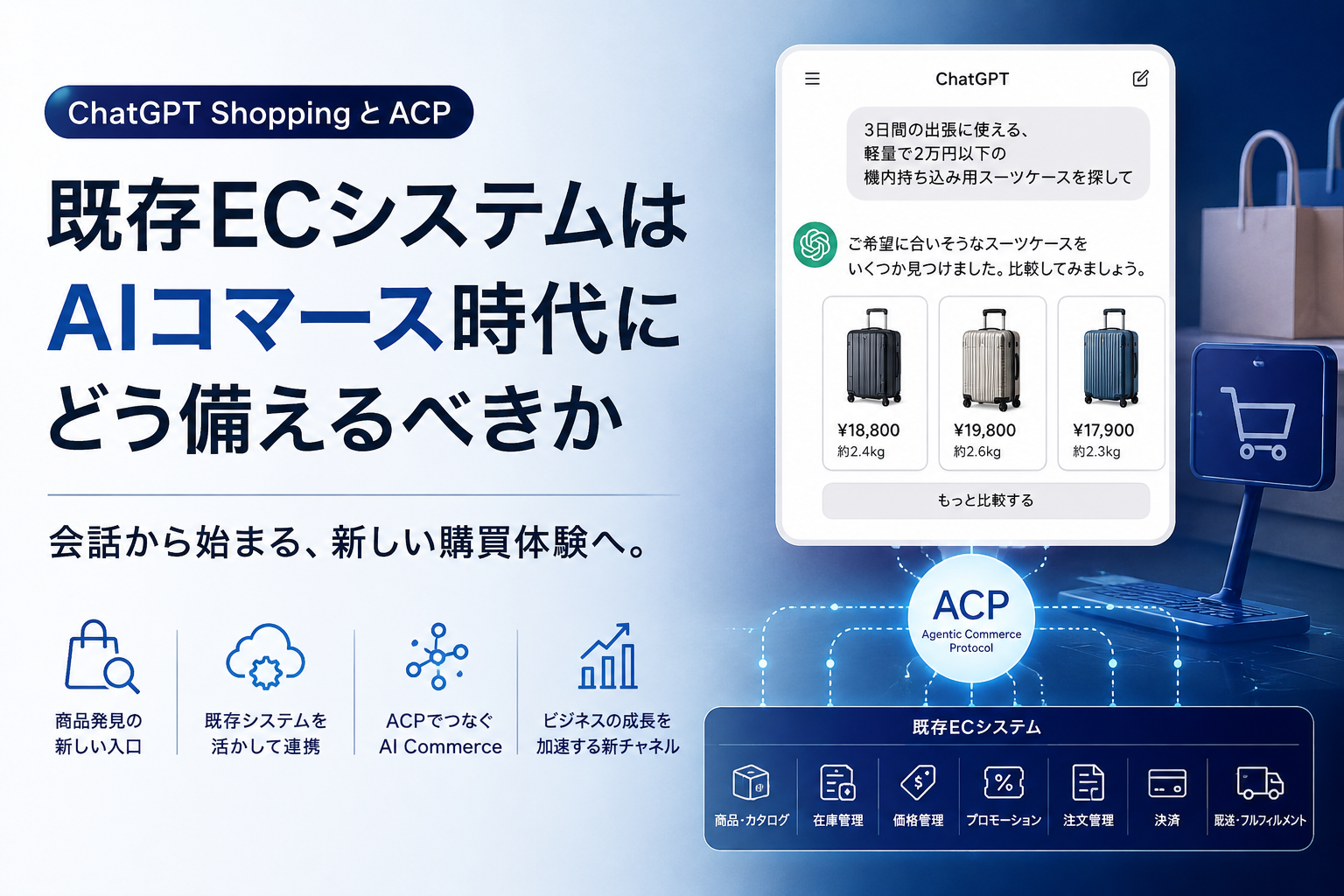
"Find me a lightweight carry-on suitcase under $150 for a 3-day business trip."
Instead of opening multiple EC sites, narrowing down products by filters, and comparing across a pile of browser tabs, users will be able to find, narrow down, and compare products that match their needs through a conversation with ChatGPT.
This is a significant shift for e-commerce.
Because AI is becoming a new interface connecting customers and EC systems.
I. From Search Commerce to Conversational Commerce
In March 2026, OpenAI announced a new shopping experience within ChatGPT.
Users will be able to browse products more visually within ChatGPT, compare multiple items, and narrow down to what fits them by adding or changing conditions through conversation.
One key mechanism behind this is the **Agentic Commerce Protocol (ACP)**.
ACP can be thought of as a layer that connects a merchant's commerce system to an AI agent.
Through ACP, a merchant can expose commerce information such as:
- Product catalog
- Product information and pricing
- Promotions
- Inventory status
- Other commerce-related data
What matters here is that companies don't need to build their entire EC platform from scratch to support AI commerce like this.
OpenAI has laid out a direction where merchants can integrate with ACP in several ways while continuing to use the commerce system they already run.
That creates a very real question for any company already running an EC business:
How do we connect our current EC system to ChatGPT and future AI commerce experiences, without replacing our existing core system?
II. The real challenge isn't just "adding one API"
A typical existing EC platform is generally made up of many systems and functions.
EC Frontend → Product / Catalog → Inventory → Pricing → Promotion → Order → Payment → Fulfillment
Meanwhile, for an AI agent to deliver a good buying experience to users, it needs to correctly understand things like:
What products exist?
Which products fit this user's needs?
What's the current price?
Are there any campaigns or promotions available?
Is it in stock?
If the user wants to buy, what happens next?
So ACP support doesn't end with simply adding a new API endpoint.
Companies need to design how to map the data and business logic in their existing EC system to a model an AI agent can use.
In particular, for EC systems that have been running for many years, it's common for product information, inventory, pricing, and promotions to be spread across multiple systems.
How to organize and consolidate that becomes a key design point in adopting ACP.
II. Bunbu's approach to bringing ACP to an existing EC system
At Bunbu, rather than starting from
"How do we build a new commerce system for AI?"
we start from the question:
"How can we make the EC system our customer already has AI-ready?"
First, we map out the current system architecture.
Existing EC System
↓
Product / Inventory / Pricing / Promotion / Order APIs
↓
ACP Integration Layer
↓
ChatGPT / AI Agent
↓
Customer
From there, we work through three main areas.
1. ACP Readiness Assessment
First, we assess how much of the existing EC system's data and APIs can be reused.
For example:
- Does the Product API have all the attributes needed?
- Is inventory information updated frequently enough?
- Which system manages pricing and promotions?
- Are Product IDs consistent across multiple systems?
- Are there business rules that only exist in the current frontend or legacy backend?
The goal of this phase is to make visible the gap between the existing EC system and what AI commerce requires.
2. Designing the ACP Integration Architecture
Not all AI-facing logic needs to be implemented directly in the EC core.
Depending on the system, an ACP Integration Layer sitting between the existing EC system and the AI agent can be an effective architecture.
This layer can, for example, take on roles such as:
- Transforming data models
- Consolidating data from multiple backends
- Standardizing product information
- Handling authentication / authorization
- Enforcing business rules
- Logging / monitoring
- Providing an abstraction that limits impact on the EC core
This makes it possible to validate AI commerce readiness while leveraging existing assets, without a large-scale EC replacement from day one.
3. Start with a PoC, not a full rollout
The environment around AI commerce is still changing rapidly.
So rather than targeting every product and every purchase flow from the start, it makes sense to begin small:
One category → a limited set of products → one use case → a limited user group
In a PoC, you can validate points such as:
- Can the AI correctly understand products using only the current product data?
- What product information needs to be added or improved?
- Can the right products be surfaced for the user's intent?
- Can the current architecture handle the required data update frequency?
- What needs improving before production rollout and scaling?
Based on the results, you can expand ACP coverage in stages.
IV. AI Commerce could become a new EC channel
Until now, companies have primarily optimized EC for the following channels:
Web → Mobile → Marketplace
Going forward, a new channel may be added here:
AI Agent / ChatGPT
If that happens, the very idea of "EC optimization" will change too.
Until now, the key question has been:
"Can people find our products on Google?"
Going forward, in addition to that, questions like these may matter just as much:
"Does AI correctly understand our products?"
"When a customer expresses their needs in natural language, are our products surfaced as a fitting option?"
"Is the price, inventory, and promotion information we provide to AI accurate and up to date?"
This could become a new layer in Digital Commerce Strategy.
V. Bunbu: From Existing EC to AI-ready Commerce
For a company that already has an EC platform, the first step isn't necessarily to rebuild the system.
What matters is:
Understanding where your existing EC stands today
→ Organizing what ACP requires
→ Identifying the gap
→ Designing an architecture that connects to AI while leveraging your existing system assets
At Bunbu, we provide consulting and technical support toward ACP readiness through steps such as:
EC Architecture Assessment
→ ACP Readiness / Gap Analysis
→ Integration Architecture
→ PoC
→ Production Roadmap
The goal isn't simply "connecting to ChatGPT."
It's making the commerce system your company already has AI-ready, for a world where AI agents become one of the key touchpoints between customers and products.