
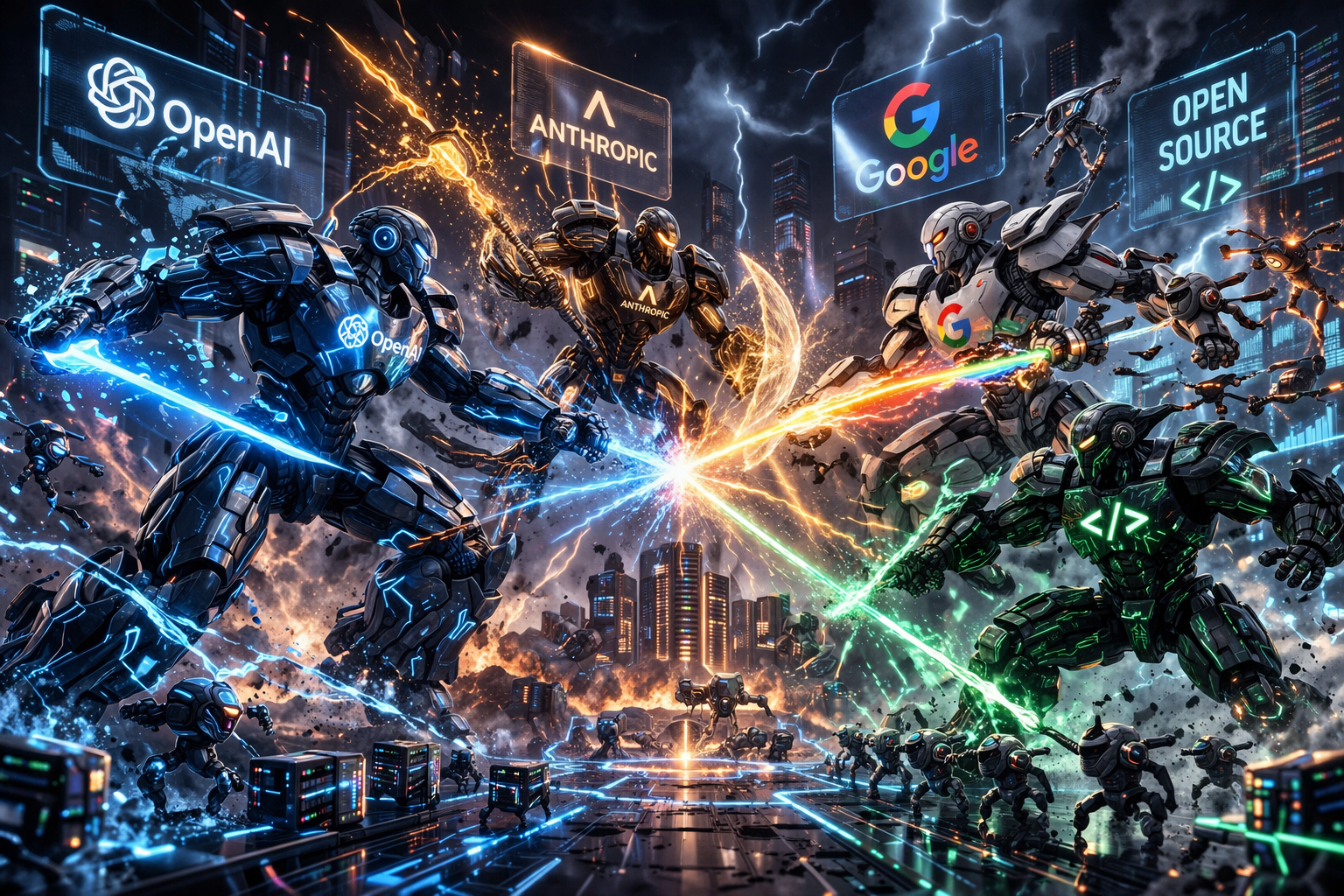
1. History repeats itself: from mainframes to PCs
In the 1970s, computers were massive machines (mainframes) sitting in the cooled rooms of large corporations and governments. Users could only access them through terminals.
- Today's OpenAI/Anthropic: These resemble a modern-day mainframe. You send your data to a server via an API or chat interface, wait for it to be processed, and receive a result back. You don't own the "brain" doing the thinking yourself.
- Open source (Llama, Mistral, DeepSeek): These are increasingly taking on the role the PC played in the 80s. As hardware (NVIDIA, Apple Silicon) gets more powerful and optimization techniques like quantization advance, very capable models can now run on a personal computer or an in-house server.
2. Why open source could become the "giant slayer"
Open source is increasingly solving, quite effectively, the exact problems that companies like OpenAI are grappling with.
- Privacy and security: Large enterprises don't want to put sensitive business data on OpenAI's cloud. An open-source model running on-premise can be the only solution they're comfortable using.
- Fine-tuning for specific needs: Retraining a closed model is expensive and comes with plenty of restrictions. With open source, a community can produce thousands of specialized derivative models (legal, medical, coding, and so on) within days.
- Marginal cost: When you run a model on your own hardware, the cost per answer approaches zero once you've made the hardware investment. Meanwhile, the more you use a major provider's API, the more you pay.
3. The "moat" is disappearing
A leaked internal memo from Google reportedly carried the headline: **"We have no moat, and neither does OpenAI."**
It emphasized that while Google and OpenAI were busy competing with each other, the open-source community was quietly solving major problems — like running a 65B-parameter model on a MacBook — at a pace measured in weeks.
4. A scenario where OpenAI/Anthropic "lose"
Even with a technological lead, they could lose momentum under conditions like these:
- Performance saturation: If a free, open-source model reaches 90-95% of GPT-4's performance, many users and companies will choose open source for the cost savings and data control.
- Advances in consumer AI hardware: If the NPUs (Neural Processing Units) built into phones and laptops become powerful enough to run "local AI" comfortably, demand for renting a "brain" in the cloud could shrink dramatically.
Summary
The future may split into two poles:
- Closed models: evolving into a role as a "massive superintelligence" tackling extremely hard problems and science-research-grade challenges.
- Open models: becoming something like the "OS" underneath every everyday app, running on billions of personal devices.